












Worshipping through Image Idolatry
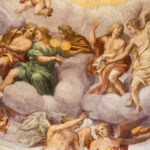
If the early church fathers knew it was sin to display images, also know as Image Idolatry of Christ, Mary, or other leaders of the church then why do you?
Concerning Jesus, how many different images of Christ are there. I’ve seen literally thousands, and they all depict a different man. Many are white with long hair and blue eyes, which is not middle eastern where Christ was born. Also, the fact that most all of them depict him with long hair would be shameful according to Saint Paul who wrote in 1 Corinthians 11:14 “Doth not even nature itself teach you, that, if a man have long hair, it is a shame unto him?” Now Paul saw the risen Christ on the road to Damascus. He knew what Jesus looked like. Do you really think Saint Paul would call our Lord shameful? I don’t think so!
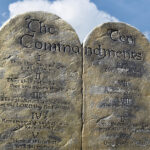
Now, about all of those pictures floating around and hanging on walls. Who had Christ pose for a portrait? How does anyone know what our Lord looked like? The first pictures of Jesus are from the third century, 300 years after he walked this earth as our Lord and Savior. God wrote in His Holy Word which Eusebius of Caesarea below pointed out “Thou shalt not make unto thee any graven image, or any likeness of any thing that is in heaven above, or that is in the earth beneath, or that is in the water under the earth. Exodus 20:4” The very reason God gave that commandment is because of what is happening today! False images of our Lord are everywhere.

The early church fathers listed below, knew the dangers of such images. They knew that God had forbidden them and so they wrote in they’re teachings not to do it. Yet, here we are today. Please consider what the early Christians said and refrain from propagating the sin we see today.
Tertullian (c.160–c.240), early Christian theologian; His Latin name is Quintus Septimius Florens Tertullianus. His writings include Christian apologetics and attacks on pagan idolatry and Gnosticism.
He required artists to cease image-making to be accepted into the church, declaring all “similitude” interdicted.
Lucius Caecilius Firmianus Lactantius (c.250 – c.325) was an early Christian author who became an advisor to Roman emperor Constantine, guiding his Christian religious policy in its initial stages of emergence famously wrote, “wherefore it is undoubted that there is no religion wherever there is an image.”
Arnobius of Sicca (died c. 330) was an early Christian apologist of Berber origin[1] during the reign of Diocletian (284–305).
He noted that pagans criticized Christians for their “very serious charge of impiety because [we] do not set up statues and images of any god.”
Origen of Alexandria (c.185 – c.253),[4] also known as Origen Adamantius, was an early Christian Scholar ,ascetic, and theologian, Famously declared that Christians, “being taught in the school of Jesus Christ, have rejected all images and statues”
Eusebius of Caesarea (c.260/265 – 30 May AD 339), also known as Eusebius Pamphilius, was a historian of Christianity, exegete, and Christian polemicist from the Roman Province of Syria Palaestina
In about AD 314 rebuked the emperor’s sister, Constantia, for requesting a picture of Christ, citing the second commandment: “Did the reading escape you where God commanded not to make any likeness of anything in heaven above or on the earth beneath?” He admitted to confiscating purported images of Christ and Paul “lest we might seem to carry around our God in an image, as idolaters do.”
Written by David M Peterson
Also read: Traditions of Men
For beautiful Christian Wallpapers/Backgrounds check out David’s Christian Images
About The Author



More Stories
Noah’s Flood – Old Earth
Behold, the days come,” saith the Lord God,…
The Black and White of the Unpardonable sin